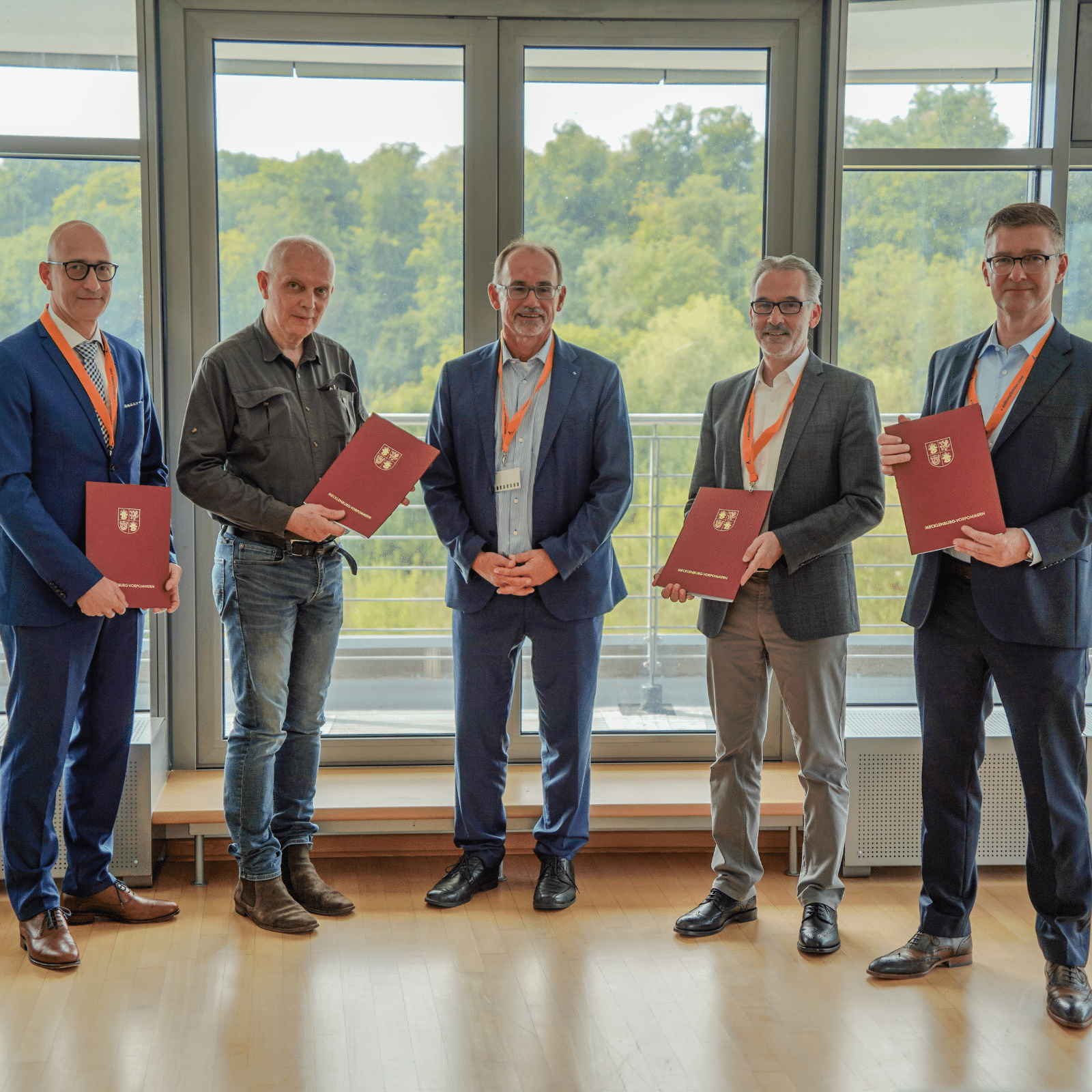
Handover of funding notifications on August 29, 2025, at Miltenyi in Teterow. From left: Prof. Christian Junghanß, Rostock University Medical Center, Dr. Stefan Miltenyi, Miltenyi Biotec B.V. & Co. KG, Dr. Wolfgang Blank, Minister for Economic Affairs, Infrastructure, Tourism, and Labor, Prof. Thomas Kirste, University of Rostock, Dr. Dirk Forberger, RoweMed AG (Photo: Carla Sophie Hannemann, Ministry for Economic Affairs, Infrastructure, Tourism, and Labor).
Launch of the NEXCELL future research association
University of Rostock develops AI-controlled digital twin for the next generation of cell and gene therapy
Miltenyi Biotec B.V. & Co. KG from Teterow, the University of Rostock, Rostock University Medical Center, and RoweMed AG – Medical 4 Life from Parchim will receive approximately €8.2 million in funding from the European Regional Development Fund (ERDF) over four years for the development of a highly automated and comprehensively digitized cell and gene therapy platform – NEXCELL. The total funding volume amounts to approximately €13 million.
Cell and gene therapies are considered key to modern medicine. They open up new treatment options for serious and previously incurable diseases such as cancer or autoimmune diseases. Through the individual use of tailor-made cells, diseases will not only be alleviated in the future, but even permanently cured. A central component of the interdisciplinary joint project is the use of artificial intelligence (AI) to create digital twins of complex dynamic systems in order to optimize manufacturing processes, improve quality, and bring new forms of therapy to patients more quickly.
Under the leadership of the internationally leading company Miltenyi Biotec B.V. & Co. KG, the consortium is developing a new generation of devices that combine standardized clinical manufacturing processes, automated analytics, AI-supported process monitoring, and the highest product quality. Other project partners include RoweMed AG, Rostock University Medical Center, and the Institute for Visual and Analytic Computing at the University of Rostock. In the participating working groups “Hybrid Methods of Artificial Intelligence and Machine Learning” (HAIML, led by Professor Thomas Kirste) and “Intelligent Data Analytics” (IDA, led by Professor Martin Becker) at the Institute for Visual and Analytic Computing, the Rostock scientists are pooling their expertise in the recording of complex dynamic processes, the analysis of biomedical data, and the use of deep learning and large language models. The aim is to effectively monitor production processes in bioreactors, efficiently process the resulting data volumes, and generate traceable documentation.
“This is an extremely exciting project, not only in terms of its significance for new therapeutic options, but also from the perspective of the AI required,” says Professor Thomas Kirste, head of the HAIML working group. “The automated production of therapeutic cells in a bioreactor is a complex process whose effective control and documentation is not feasible without AI, given the massive amounts of data involved. Our hybrid methods offer new possibilities for building digital twins of such systems. We are therefore very pleased to be able to support NEXCELL with our AI expertise.” The state is supporting the project with four positions for HAIML and IDA worth 1.6 million euros.
The joint project is part of the Regional Innovation Strategy for Smart Specialization Mecklenburg-Western Pomerania 2021–2027 in the field of medical technology and biotechnology.
Press release from the Ministry of Economics, Infrastructure, Tourism, and Labor: https://www.regierung-mv.de/serviceassistent/_php/download.php?datei_id=1682070